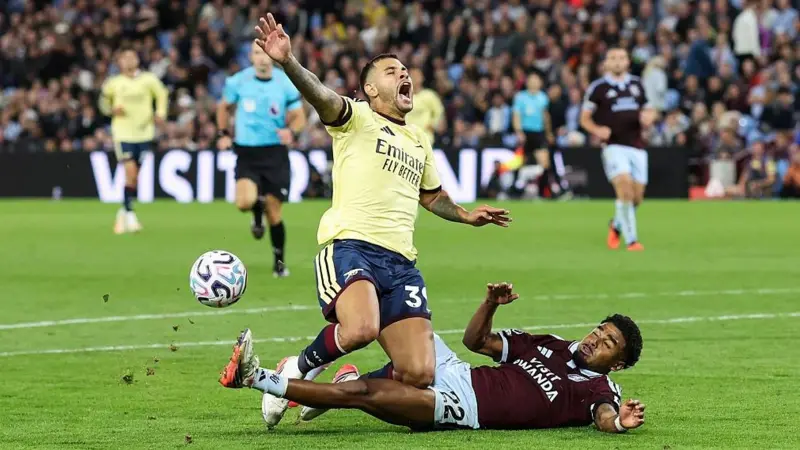

Arsenal’s narrow victory over Aston Villa has been given a significant refereeing postscript after the Premier League’s Key Match Incidents (KMI) Panel ruled that the Gunners should have been awarded a penalty late in the game.
The independent panel concluded that Aston Villa defender Ian Maatsen committed a foul on Bruno Guimaraes inside the penalty area during the closing stages of Arsenal’s 1-0 victory.
It also ruled that Maatsen should have received a second yellow card for the challenge, which would have resulted in his dismissal.
The incident occurred deep into stoppage time, with Arsenal holding on to their slender advantage. Guimaraes broke into the Villa penalty area and attempted to get a shot away before Maatsen made a desperate challenge to prevent the Brazilian midfielder from finishing the attack.
However, referee Jarred Gillett did not award a penalty, while VAR official James Bell did not recommend an on-field review.
Following its review, the five-member KMI Panel unanimously determined that the decision made on the pitch was incorrect and that VAR should have intervened. The vote was 5-0 in both assessments.
“Clear contact was made on the attacker’s standing leg and Maatsen made no contact with the ball,” the KMI Panel said.
The panel went further in its assessment of the disciplinary aspect of the incident, concluding that Maatsen’s challenge was reckless and therefore deserved another booking.
It added that “the challenge was reckless and therefore a second caution should have been awarded”.
The decision means Arsenal were not only denied what the panel considered a legitimate opportunity to extend their lead from the penalty spot, but Villa should also have finished the match with 10 players.
Why the KMI Verdict Matters
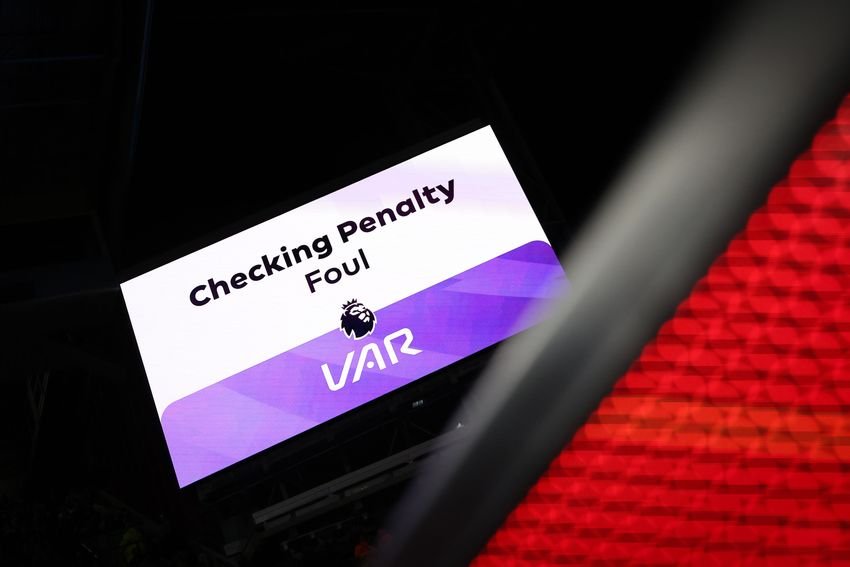
The ruling carries particular significance because the KMI Panel is designed to provide an independent assessment of major refereeing decisions in Premier League matches.
Introduced during the 2022/23 season, the panel consists of five members: three former players or coaches, one representative from the Premier League and one representative from Pro Ref.
Its role is not simply to revisit every controversial decision. Instead, the panel reviews designated Key Match Incidents, including penalties, red cards, second yellow cards, goals, offside decisions and other major situations falling under the referee’s jurisdiction.
The panel’s findings are particularly relevant during the 2026/27 season because the Premier League has begun publishing its KMI results weekly, giving supporters greater transparency over how contentious decisions are assessed after matches.The process involves two separate stages.First, each panellist considers whether the referee’s original decision was correct or incorrect.
If the panel decides that the on-field decision was wrong, the members then consider whether the mistake reached the high threshold required for VAR intervention — namely whether it constituted a clear and obvious error.That distinction is important because a referee can be judged to have made the wrong decision without the incident necessarily qualifying for VAR intervention.
The KMI Panel therefore assesses the referee’s decision and VAR’s responsibility separately.In Arsenal’s case, however, the panel found no such distinction. The members unanimously agreed that Gillett’s failure to award the penalty was an error and that Bell should have intervened.
The incident therefore represents a particularly strong criticism of the officiating process because both the original decision and the failure to intervene were judged to be incorrect.
How the KMI Panel reaches its decisions
The incidents considered by the panel are identified during matches and through post-match analysis. The Premier League and Pro Ref then jointly agree the final list of KMIs according to pre-agreed thresholds.
Before each meeting, the panellists receive video clips of the incidents selected for review. They watch the footage collectively before discussing each situation and casting their votes.Their assessment is based on their football experience, while also taking into account the Laws of the Game, Premier League football principles and guidance issued by Pro Ref.
The system is intended to provide an independent perspective rather than simply reinforce the opinions of match officials. Its conclusions can also help the Premier League and Pro Ref identify areas where officiating consistency and decision-making may need improvement
For Arsenal, the latest verdict offers official confirmation of what was a highly contentious moment during a match they ultimately managed to win.
Other KMI Rulings
The KMI Panel also made inquiry into incidents in another Premier League game played during the weekend.
The Panel’s findings also addressed another controversial incident involving Manchester United’s 5-2 victory over Ipswich Town on August 30.
Manchester United’s second goal attracted considerable attention because the ball appeared to strike Harry Maguire’s hand as he controlled it just outside the penalty area. Maguire subsequently produced a shot that was heading wide before it took a decisive deflection off Ipswich defender Jacob Greaves and ended up in the net.
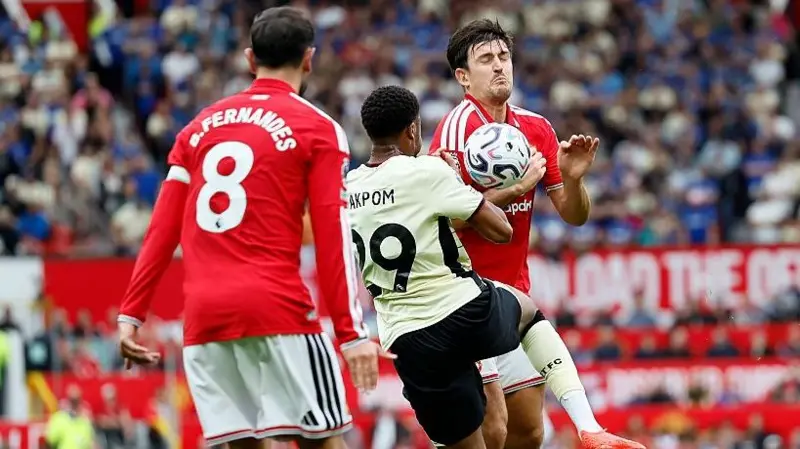
The goal was therefore recorded as an own goal rather than a goal for Maguire.Referee Craig Pawson and VAR Jarred Gillett judged the handball to be accidental, allowing the goal to stand.
The KMI Panel subsequently supported that decision by a 4-1 vote, although one member believed the handball was deliberate. The panel noted that Maguire’s arms were within his bodyline and that the contact with his right arm was accidental. Crucially, Maguire was not the eventual goalscorer because the ball was deflected into the net by Greaves.
The decision illustrates how the panel can reach a different conclusion from popular opinion surrounding a controversial incident. While the handball generated debate, the majority of the KMI members agreed that the goal had been correctly awarded.
The panel also reviewed the incident that led to Manchester United being awarded a penalty involving Matheus Cunha and Jacob Greaves.
In that situation, Greaves was shown a yellow card for his challenge on Cunha as the United forward advanced towards goal.The on-field decision to award a penalty and issue Greaves with a yellow card was supported by the panel.
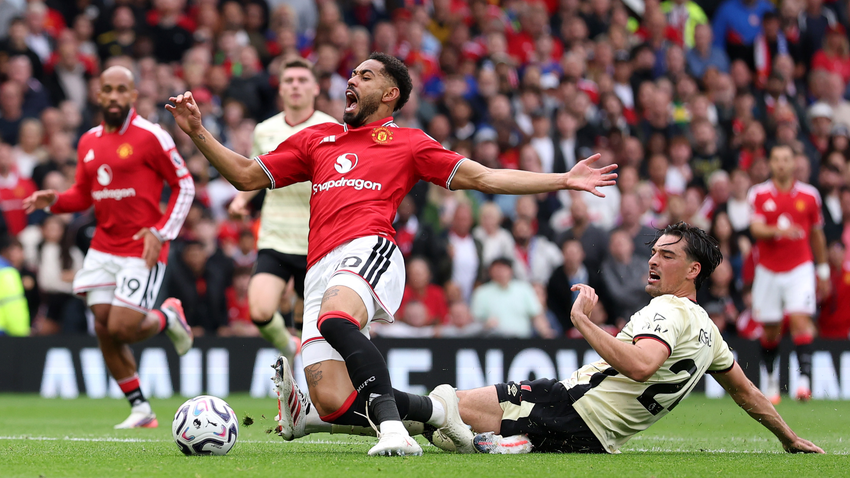
The challenge was regarded as a genuine attempt to play the ball rather than a deliberate act designed solely to stop Cunha.That ruling further demonstrates the distinction the KMI Panel makes between a foul and the level of disciplinary punishment required. A challenge can be judged to be a clear foul without automatically warranting a red card.
More transparency, but Arsenal will keep the points

The KMI Panel’s verdict may provide Arsenal with official confirmation that they were wronged during the closing stages against Aston Villa, but it cannot alter the result.
The Gunners left Villa Park with the three points after securing a 1-0 victory, and the late incident did not ultimately prevent them from taking maximum points.
Nevertheless, the ruling gives greater clarity to a moment that could easily have changed the complexion of the match. Had the penalty been awarded and Maatsen sent off, Arsenal would have had an opportunity to put the result beyond doubt while Villa would have been forced to finish with 10 men.
Instead, the decision remained unchanged on the night. The KMI Panel’s subsequent ruling now provides the official assessment: Arsenal should have had the penalty, Maatsen should have received a second yellow card, and VAR should have intervened.
For a Premier League increasingly focused on improving transparency around officiating, the verdict demonstrates precisely why the KMI system has become an important part of the post-match conversation.



Comments are moderated before appearing.