
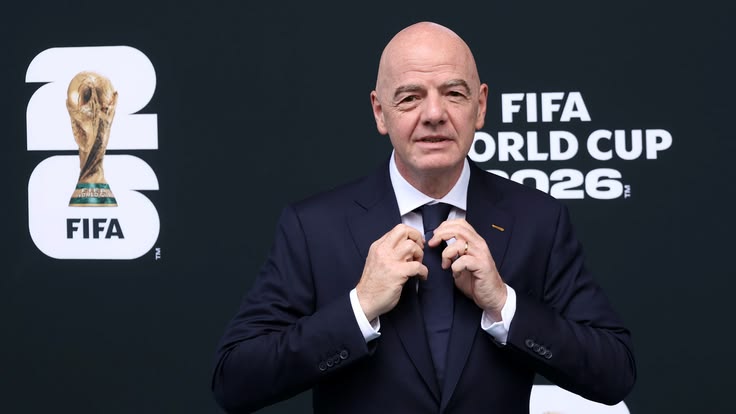
FIFA president Gianni Infantino has officially confirmed that he will scrap the proposed World Cup investment plan, bringing an abrupt end to one of the most controversial governance ideas in recent football history.
The 56-year-old admitted that the project had created deep divisions within global football and no longer aligned with its original objective of strengthening the game.
The proposal initially aimed to establish a commercial subsidiary that would manage FIFA’s major tournaments, including the prestigious World Cup.
Under the plan, FIFA intended to invite external investors to purchase minority, non-controlling stakes in a newly created entity known as FIFA Forward Enterprise (FFE).
This structure was designed to centralize and commercialize broadcasting rights, sponsorships, ticketing, and licensing, potentially unlocking massive financial gains for the organization.
Infantino had previously set a September 19 deadline for football federations to approve the proposal, offering financial incentives—reportedly up to $20 million (£15 million)—to associations willing to support the initiative. However, despite the financial appeal, the plan quickly lost momentum as opposition mounted across the footballing world.
A staggering 143 out of FIFA’s 211 member associations rejected the proposal , making its implementation virtually impossible. The resistance highlighted widespread concerns about the commercialization of football and the potential risks of involving private investors in the governance of the sport’s most valuable competitions.
Further controversy emerged when reports suggested that Infantino had not fully informed some of FIFA’s eight vice-presidents about the proposal.
Critics argued that the plan lacked transparency and that although this initiative could have raised as much as $10 billion (£7.5 billion), it still doesn’t allign with FIFA’s policies.
Ultimately, the overwhelming backlash forced FIFA to reconsider, marking a significant retreat from what could have been a transformative—but divisive—shift in football governance.
IMPLICATION ON INFANTINO’S PRESIDENTIAL CAMPAIGN
Gianni Infantino’s decision to abandon the investment plan comes at a critical time in his leadership tenure.
He first assumed office on February 26, 2016, after winning the FIFA presidency at the Extraordinary Congress in Zurich, defeating Sheikh Salman by 115 votes to 88.
Looking ahead, FIFA’s next presidential election is scheduled to take place at the 77th FIFA Congress in Morocco, where a new president will be confirmed. Candidates have until November 18 to declare their intentions.
Prior to the controversy surrounding the FFE proposal, Infantino was widely expected to secure re-election unopposed, with numerous football associations—including several in Europe—already indicating their support. However, the events surrounding this failed initiative have introduced a level of uncertainty into what once seemed a straightforward path to another term.
It remains unclear whether the backlash will lead to a withdrawal of support from member associations, potentially opening the door for challengers.
The situation has exposed divisions not only among confederations but also within FIFA itself, raising questions about leadership, transparency, and decision-making processes at the highest level of football governance.
Infantino has maintained that the proposal was designed to strengthen member associations, particularly in regions where financial support is most needed. However, the resistance it generated suggests that many stakeholders viewed the plan as a step too far in the commercialization of football.
The controversy also triggered internal consequences, most notably the resignation of Carlos Cordeiro.
Cordeiro, who had represented FIFA on the White House taskforce for the 2026 World Cup, stepped down over the proposal .In his statement, he made it clear that he “unequivocally” opposed the plans, rejecting the notion that FIFA required external investors to unlock value.
He also emphasized that he had no involvement in the proposal, further underscoring the internal disconnect within the organization.
This resignation not only added weight to the opposition but also highlighted the potential political cost of the failed initiative on Infantino’s leadership and future ambitions.
WAY FORWARD FOR FOOTBALL
The collapse of the FFE proposal has reignited a broader debate about the future direction of global football governance.
Prominent political voices, including Andy Burnham, have strongly opposed the idea of introducing private investment into the sport’s most iconic competitions.
Burnham famously stated:
“Football does not belong to investors. It belongs to the people who fill the stands and who stand on the touchline week in, week out, rain or shine.”
This perspective of his reflects a deeply rooted belief that football is more than just a commercial enterprise—it is a cultural and social institution that should remain accessible and authentic.
Critics argue that even the sale of a minority stake to private investors could set a dangerous precedent, potentially leading to increased commercialization and reduced influence for traditional stakeholders such as fans, local communities, and smaller football associations.
For many, the fear is that such changes could “adulterate” the essence of the sport, transforming it into a profit-driven industry at the expense of its historical values and global inclusivity.
Football has long been celebrated as a game that unites people across economic and social divides, and any move perceived to threaten that identity is likely to face strong resistance.
In the aftermath of the failed proposal, FIFA now faces the challenge of rebuilding trust among its member associations and stakeholders. Moving forward, the organization may need to adopt a more transparent and inclusive approach to decision-making, ensuring that major reforms are developed in collaboration with the wider football community.
Ultimately, the situation serves as a reminder that while financial growth is important, it must be carefully balanced with the core principles that define the sport. Football’s global appeal lies in its accessibility, passion, and sense of belonging—qualities that must be preserved at all costs.
As the dust settles, one thing remains clear: football should continue to belong to the people, retaining its place as the world’s most beloved game.

Your email will not be published. Comments are moderated before appearing.